
From “Death of the IG Party Flyer” over at NINA:
“Semi-secret shows and anti-Instagram promotional strategies hold obvious appeal for audiences who want to be in on something, so how under-the-radar can these projects stay? And if the Wedding Planners do manage to stay relatively offline, can they stay afloat in a scene that is as expensive and competitive as New York? For now, they seem unconcerned with that, focusing on building community and giving musicians a place to play.”
There is allure in belonging to something small, to something that not everybody knows about. Social media got us grasping for more instead of focusing on living in the moment.
Don’t forget – we had a good thing going with music blogs in the early 2000s, before the techbros and investor hawks swooped in and bled it dry. The CPMs couldn’t keep up, so they built up the social media racket, which – if you love tragedy, hate, AI slop, and worse – well then, you’ll love it. And it’s ready to implode. Maybe not “Facebook closes up shop” implode, but enough so that the culture makers and curators and artists abandon ship.
History repeats itself, which is why if you have a foundation of creative friends, enthusiastic weirdos, and vibrant beings you’ll be just fine.

A musician with some impressive Spotify numbers wrote me for a bit of Email Guidance, asking how to get people from streaming music platforms to a paid Substack or Patreon. Here’s part of my reply (lightly edited):
Open a Substack account TONIGHT and start filling it up with stories. Give your fans a place to DIVE INTO. You can build a real website later.
Get 10 posts up there. Twenty.
Buy a domain name at Hover.com, point that domain to the Substack.
Stop using LinkTree. Stop driving everyone to platforms where you can’t reach them.
Get them to your Substack, where you can still embed all your music, and your videos. And that’s where everyone can SUBSCRIBE to your email list. Be RUTHLESS about it.
Get people to YOUR SITE FIRST. That is your mission.
Then go play shows. Have a clipboard and a pen to get people on your email list. Hand it out before your third song to someone in the crowd so people sign it while you’re playing (inspired by this story from Jes).
Send a newsletter once a week, or twice a month. Subscribe to other musicians on Substack and see how they do it. “Steal like an artist,” like Austin Kleon says, and develop your own rhythm and style.
Make your newsletter something that someone wants to open, and not just “hey I’m playing somewhere next week,” or “listen to my new song.”
There’s lots of shortcuts in the online music world, but that just means that everyone is taking them, too. You gotta be where they can’t be, and that’s strumming a guitar in front of 15 people on a Tuesday night.
Community is your unfair advantage. Whether you’re a musician, a writer, a photographer, whatever – you need other people in your corner. You need fans and friends more than you need funnels and lead magnets.
Yes, you can play the streaming music lottery and maybe hit it big. That’s because the casino has to pay out on occasion, otherwise people stop going to the casino.
The choice is yours; keep playing the lottery, or make better bets.
“It’s absurd how we’ve come to think that reaching thousands of random people will be more impactful to our lives more than meeting a handful of people with whom we share interests and goals.”
That’s from Matilda Lucy (from ‘What do you measure when the metrics don’t matter?’), and it’s spot on – meeting a few people every week and pulling them into your creative orbit is what’s going to build the foundation for your work for the decade ahead.
That reply above was just a snippet. I usually write 1,000 words to folks reaching out for Email Guidance. I’m not saying I got all the answers, but I can put you on the path to finding them. The first email is free, too.
From Cody Cook-Parrott’s recent newsletter, “Marketing without Instagram: does it even work?”
“One of the most meaningful things about this round of Witnessing Practice was promoting the entire class without using social media. As I return to a phase of being fully off all platforms, I still bump into that old fear:
Will my business work without Instagram?
But the answer keeps being yes.”They’ve got 6,000 people on their marketing email list, and 27,000 subscribers to their Monday, Monday newsletter.
They had 171 sign ups.
Now, please understand this: 171 people is just 0.5% of their total email audience.
Not even 1% “converted,” but they still made $8,109 (gross).
Don’t make the excuse that you only have 20 subscribers. Or that growing your audience is harder these days.
Instead, ask how you can get 0.5% of your subscribers to do anything. Click a link. Reply. Hit save. Buy something.
That’s why getting 5% of an audience is hard. That’s one person out of 20. But if you can make that happen, you’re onto something.
“Getting to know other artists, writers and musicians is far more fun than optimizing a newsletter, for sure.”
This is from James Hart [here], in response to my post “You’re Not Marrying a Platform.”
Cody Cook Parrot said in their recent Witnessing Practice workshop that you can make a thing and share it with a few people.
You don’t need to launch your new website with a big press announcement. You probably don’t need to post it on social media, either, because 95% of your followers won’t see it anyways.
This is why we need a few people we can send snippets via email, get on a Zoom call, meet in person, even get on the phone.
MrBeast says that when he was starting out, him and a few friends would be on Skype all day and night, working together just trying to figure out YouTube.
Imagine if you spent just an hour a week doing that with your creative friends?
I’ve seen so much fear in people’s eyes over picking the right email marketing platform (Substack, Kit, Flodesk, Buttondown, Mailchimp).
People’s voices start to shake when choosing the right online store (Shopify, BigCartel), the right website builder (SquareSpace, Cargo, Wix, WordPress).
You’re not getting married. You can break up with these tools at any time.
Instead of spending the next few weeks bouncing between platforms or watching 24 hours of “Beehiiv vs Substack” comparison videos, talk to other creative folks in your orbit.
I host weekly virtual co-working sessions with musicians, writers, and artists.
You can ask me direct via my Email Guidance offering and I’ll get your going in the right direction.
I also host paid-community Zoom calls, where we talk about zines, IRL events, and make fun of social media (it feels great). Get a 30 day trial for $15.
Alex runs BATCAVE, “a place to help one another dive deep into the stuff.”
Cody runs Landscapes, “a writing group for all genres.”
Jes is a musician and hosting a “hands-on session exploring the four most powerful and underused practice tools.
Kate Ellen is hosting a “Go Dumb Meet Up” which is “a zoom meet up to chat about how to temporarily or permanently break up with your smartphone.”
Mansi has The Ripple Circle, a place for “authentic sharing, gentle witnessing, and the longer echo of our practice together.”
It’s not just about deleting an app, it’s about finding new places to inhabit, daring to believe in a world without Musk or Zuckerberg being central to our ability to earn a living.
This is how we escape social media, and we’re getting better at it every week.

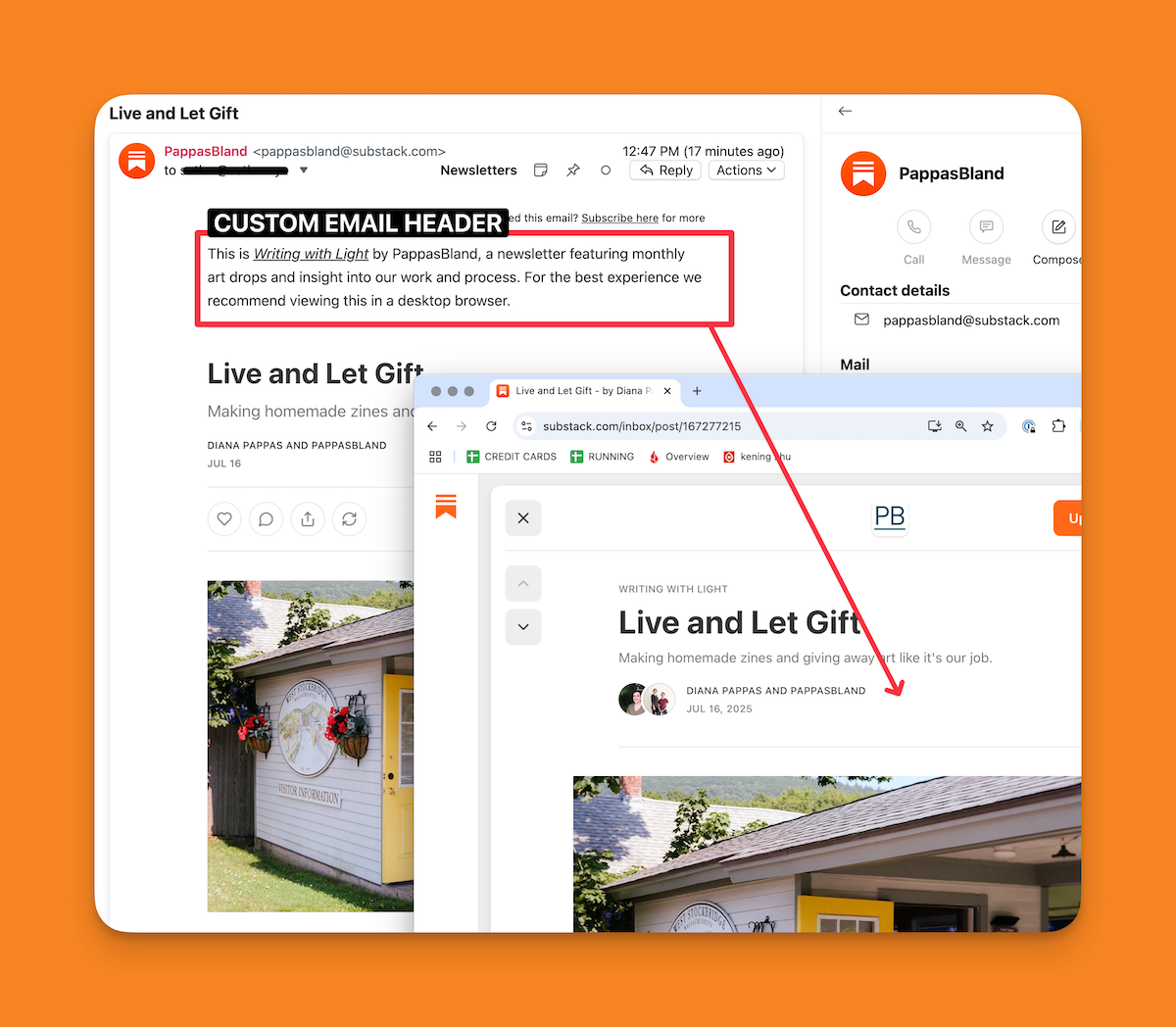
Be careful if you’re sending important information in the custom header or footer of your Substack newsletters. If you’re sending Zoom information or Luma invites or other special links to paid subscribers and they’re reading your newsletter in the Substack App, they won’t see it.
This is troubling, as Substack just recently said this:
We’re doubling down on the Substack app, which is designed to help audiences reclaim their attention and connect with the creators they care about.
Get everyone to subscribe to multiple publications, then users have messy inboxes. The cure? Just use the Substack App!
Then, when a publisher leaves Substack and sends a newsletter via a new service, the email will show up a users inbox again – this can be jarring!
“Wait, I thought I was getting all my newsletters in the Substack app?!?!”
So now it’s almost like people won’t be subscribed to a newsletter, they’ll be subscribed to a Substack.
This seems like a slippery slope.
I first saw Kareem Rahma doing Keep the Meter Runnin on Instagram. Then Subway Takes a bit later. Absolutely fascinating talk about his journey, and just how much work and effort goes into putting these sorts of projects together.
I love this part so much:
I had bet on myself so many times that I accumulated so much junk that was useful. Junk knowledge, junk information, junk intangibles. Like, that’s a lot of stuff too—the intangibles. Like, saying “100% agree” or “100% disagree” was not a part of the plan. It’s just what came out of me.
The biggest hook in the show wasn’t planned, it just happened. But it “just happened” because of the many years of accumulated “junk.” It’s easy to think of things that didn’t quiet make it as failures, but maybe it’s best to reframe those as “junk knowledge!”
(more…)On today’s Escape Pod Zoom Call we got talking about experiences with magazines when we were younger:
- One story was about a computer magazine with a program written by a young Bill Gates.
- Another was about buying magazines (plural) with a baggie full of change.
We don’t just talk about the XYZ’s of quitting social media, but about getting back to the core life experiences that made shit cool before techbro platforms flattened culture and gamified everything.
You’re tired of social media, but wondering if there’s life after the newsfeed. That’s exactly what we figure out here – together. 🏳️🌈🏳️⚧️
→ See our upcoming Zoom schedule
Say hello. Ask about working together. Tell me how you’re doing: seth@socialmediaescape.club
Subscribe via RSS