
Category: WritingCategory: Writing
What’s interesting from today’s Tool Time Show and Tell call was how it eventually got to paper. Like notebooks, planners, wall calendars. We talked about how the brain reacts different to writing with a pencil, in a different way than just typing.
It’s not just a pencil, it’s a tool. For centuries we wrote, physically, and there were tools involved, that we used with our hands.
You can have music playing all day on your computer, but with vinyl and CDs you need to physically interact with them.
There is no infinite scroll with physical objects. No endless playlist.
I can add 100 things to my todo app, but there’s only so many things I can write on a legal pad.
Emma Gannon, in a piece titled “My honest thoughts about Substack,” wrote about being on a panel at SXSW London last year:
“I was asked a question about ‘growth’. I said I was more interested in maintaining what I have. The audience looked disappointed. They wanted me to say something about growth. They wanted hard growth statistics, a neat formula for selling to advertisers. I had no tips or hacks, apart from: I write a lot.”
Sure, you could be all, “that’s easy for Emma Gannon to say, she already has 80,000 subscribers!”
But she got there by paying attention to those first 10, 100, 1000. You aren’t gifted 80,000 subscribers without first feeling what it’s like writing to 8,000 people. There are mistakes you make and lessons you learn on your way to 10,000. I think she’s been at this for like 15 years, too. Come on, people. This takes time.
The allure is growth, of course. The rush of 100 new subscribers is real! It’s sexy! But maybe it’s a better use of your time to maintain what you have.
I dare you to write a personal email to one of your people. Not a marketing email, or an invite to an event, but a genuine note. A follow up from a conversation you had a month ago. Or kudos for a job well done.
Maintain what you have, or you might not have it for long.
For the last decade we’ve put our best work on social media – videos, images, hot takes – you name it! But with so much time and energy devoted to publishing on so many platforms, our websites and newsletters just became digital brochures; static and boring.
So it was refreshing to hear Natalie Brite on Amelia Hruby’s Off the Grid podcast talking about where we limit our imagination.
“For so many entrepreneurs and micro businesses … this total dependency, where there’s no imagination outside of social media, it’s like my imagination stops at social media marketing and it’s like there’s so many other ways, right?”
I’ve seen this for decades. I was one of the first 3,000 people to sign up for Twitter. I’ve subscribed to a lot newsletters since I began this journey in 2001.
(more…)Someone emailed me how they would paywall their work after 90 days, and was looking for some thoughts and ideas on growth and such.
First — are you “married” to the paywall? Is this paying your rent right now? I don’t want to say anything flippant if it’s keeping the lights on. But since you mention wanting to ditch it, I get the feeling you’re still figuring it out, just like we all are.
I experimented with a paywall for a while, and I hated sending my newsletter to five people at a time. I appreciated the money and support, but I didn’t appreciate that my best work was only being seen by a few people. What if the post that deeply resonated with one paid member could have attracted 100 new readers?
Every piece we put out into the world is a chance for the right person to find it. Especially when you’re just getting started. You’re coming up on a year on Substack. There are people who have just discovered you, maybe told their friends, and a large part of your work is inaccessible until they pay.
I fully believe we all need to get paid. But I think we need to build trust first. And we build trust when we’re our most comfortable selves, instead of worrying about paywalls, page counts, SEO, all of that. Get your work out there in ways you can sustain. A website and a newsletter, for example. When you start adding TikTok, long-form YouTube, and everything else, that’s where things get hectic.
The more of yourself you put out there, the more people can see and feel and read, the faster you’ll discover how they actually want to support you.
I started my Substack in 2021 and didn’t rebrand to until 2023. That’s when I started hosting Zoom calls, just kind of like, “I want to talk to more people about this stuff.” And that’s when I discovered people really wanted to talk about it, too. And that some of them would pay to be part of it. Not in some guru-funnel way, but genuinely: I had to try a bunch of different things before I found what worked for me.
Reduce friction. Get to the core of what you want to be doing, without giving yourself too many side gigs to make it work.
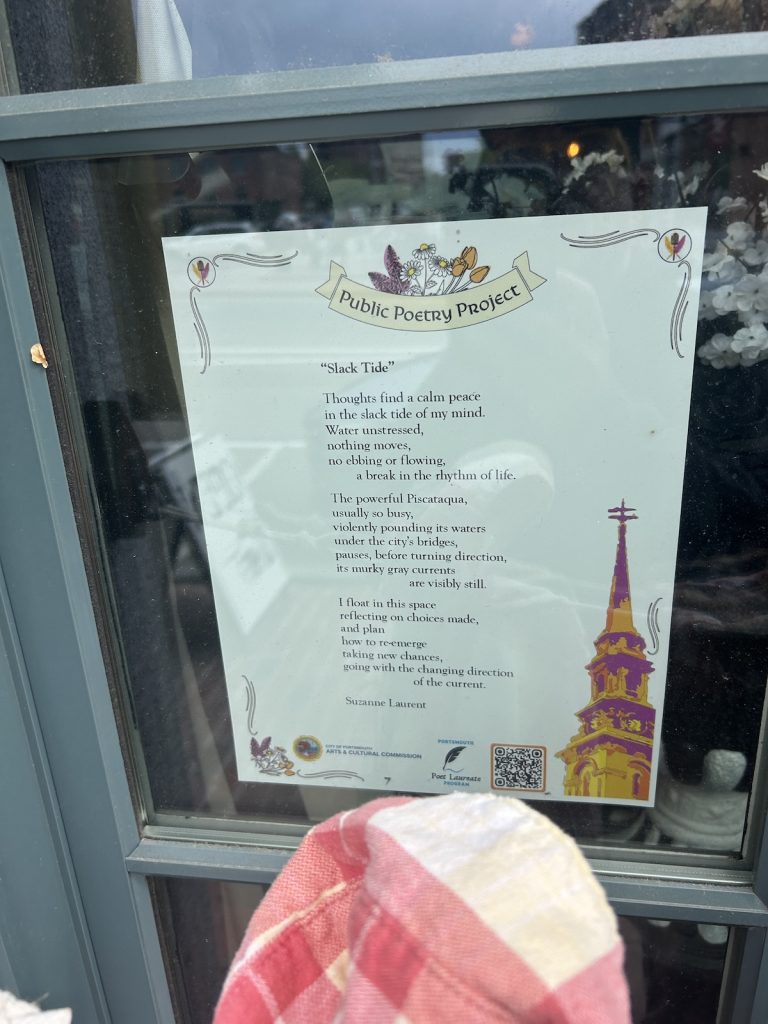
Saw this while walking around Portsmouth, NH, from the “Public Poetry Project.” This is run by the Portsmouth Poet Laureate Program, where they organize submissions from poets to be featured in businesses around town.
There are people who would love your work and they aren’t even on social media – they might just be out walking around town!
This is a club for creatives, small business folk, and just about anybody else looking to break up with social media and big tech.
🏳️🌈🏳️⚧️🇵🇸
→ See our upcoming Zoom schedule
I’m Seth Werkheiser! Get in touch: seth@socialmediaescape.club
Subscribe via RSS