

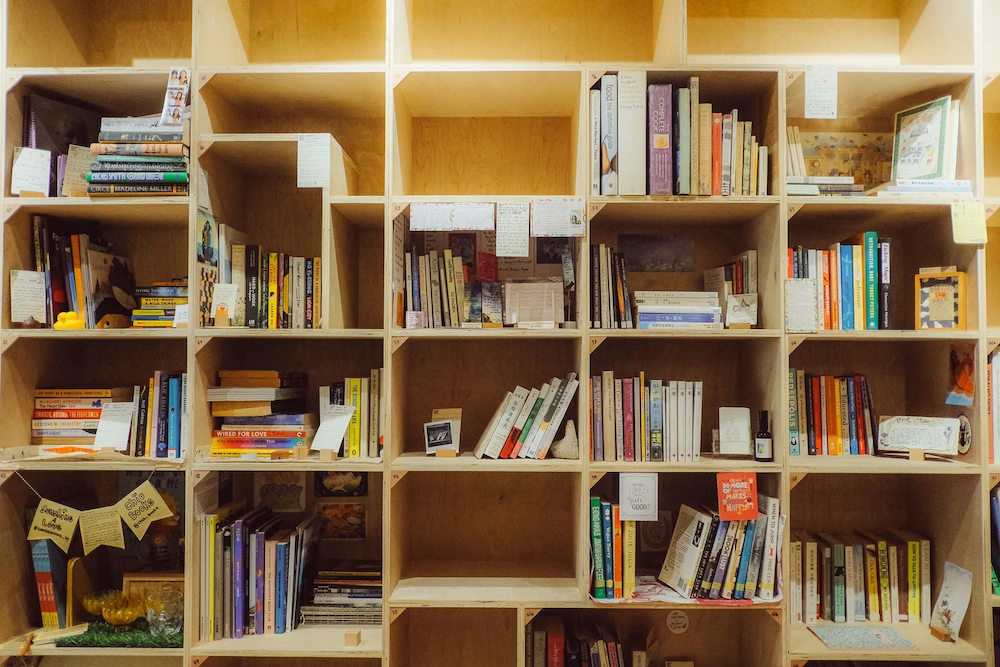
At the casual poet library in Singapore you can rent a bookshelf and curate your own little space as a way to contribute and support the library.
The thing I love about this is you don’t need a million followers on TikTok for it to work. A spot like just needs 50-100 people in the area who love the space and the mission to pay SGD$565 per year to rent a bookshelf.
On top of that, library members pay a yearly fee to borrow five books a month.
Today’s thinking is “how can I get everyone on the internet to care?” Or, “how do I find my audience on the noisy internet?”
Instead, can we imagine our mission on a smaller scale, without the need for viral attention?
From an interview with Craig Lewis earlier this year:
“Do I believe we can exist without social media? Absolutely I do.
There’s so many ways that we can get in touch and build community and build audience and build a fan group around what we do without putting all our magic onto other people’s platforms.”
For some, posting on social media can be dangerous, as South Central Run Club explains:
“Most of our runners are Black and brown and you never know when ICE is gonna pull up. Instead of broadcasting our runs and making us vulnerable to surveillance, we stopped putting it on Instagram to make people feel safer to come and hang out.”
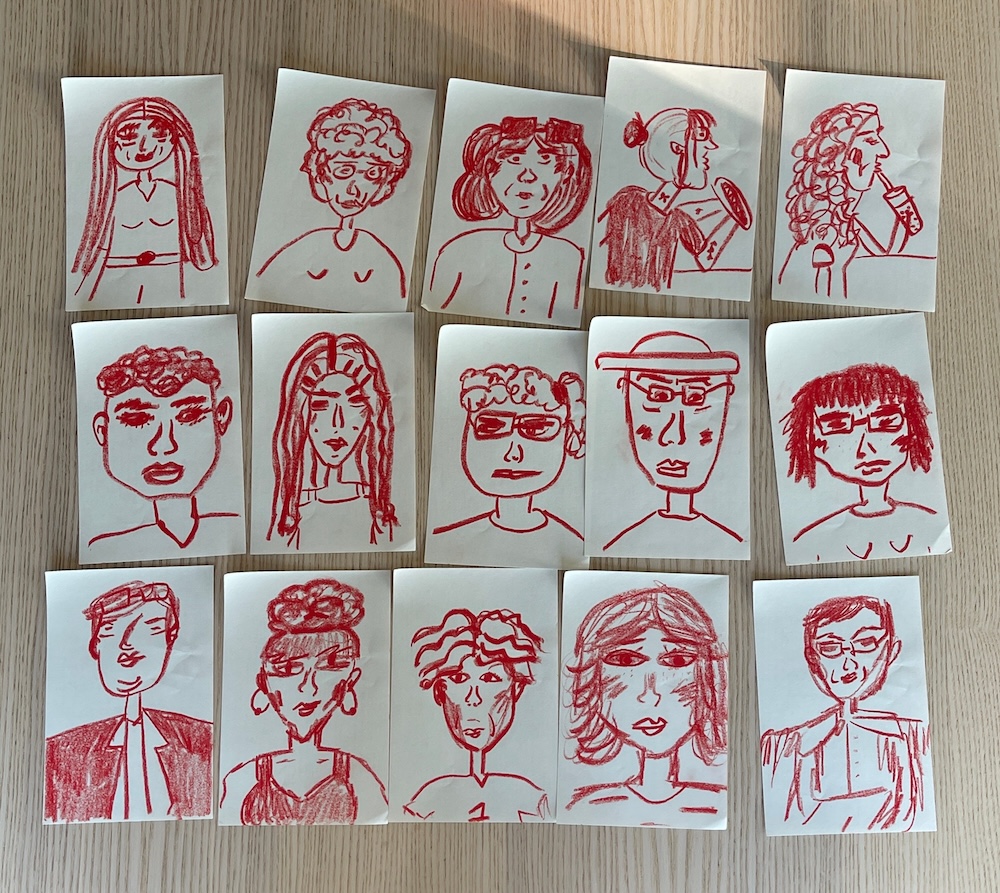
Love this from Florencia Ornelas:
“I gave myself the task to sketch as many strangers as possible during my commute to work instead of scrolling and it was a great exercise to get my creative brain working and have something to look forward every day before working 9-10 hours on my laptop.”
If we wait until we’re a full time artist, we might be waiting a long time. Better to start right where we’re at, with what we’ve got, with the time that is available.
We don’t become great in 10 minutes, but we can get a little better 10 minutes at a time.
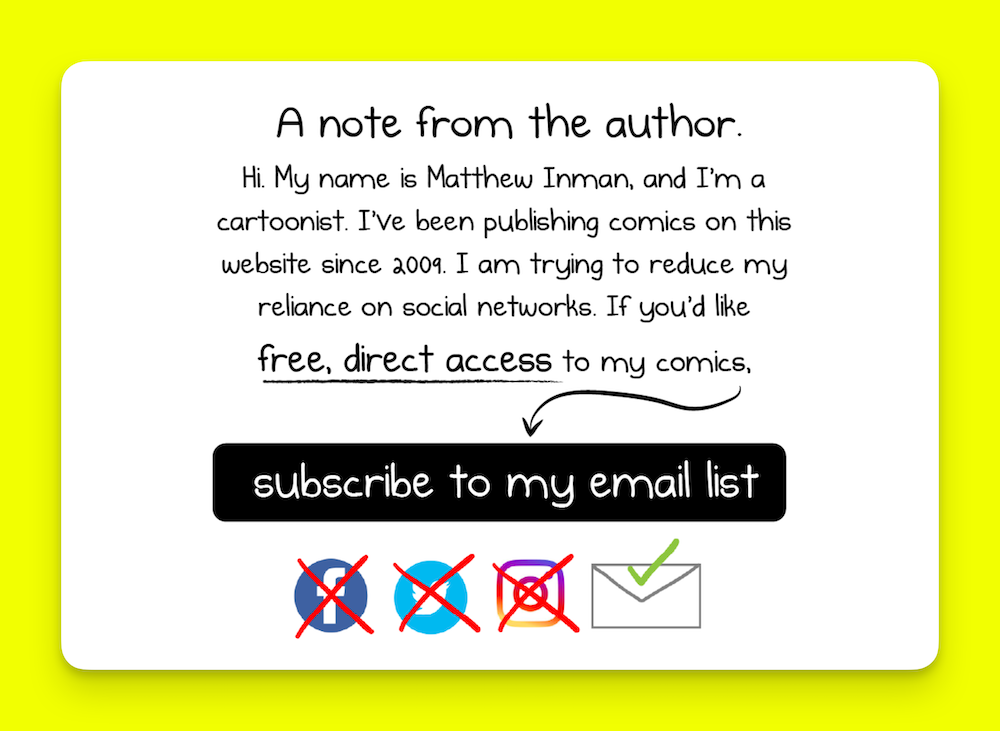
Saw this at the bottom of The Oatmeal’s very excellent post “A Cartoonist’s Review of AI Art.“
As I said back in 2023, “stop telling fans to follow you on platforms that are built to limit your ability to reach them.”
If you (or the Oatmeal) drive 1,000 people to Instagram and they all follow you, you’ll be lucky if 100 of those people see your next post.
So why not just focus on getting 100 new email subscribers? That’s a lot easier than trying to update several other platforms just so 90% of your followers won’t see your latest stuff.
Join me (Seth Werkheiser) and the Social Media Escape Club community for a 90-minute PIZZA PARTY.
Have you wanted to start a GROUP ZOOM CALL but don’t know where to start? Start here!
I believe magic happens when we gather people to trade ideas, share challenges, and remember we’re not doing this alone, so this month we’re diving into how to get started with building small, intentional spaces online.
We’ll talk about setting intentions, grounded hosting, and the mix of safety and spontaneity that keeps people coming back.
Some stories, examples, and a few practical ideas you can try with your new (or next) Zoom gathering, creative circle, or a community get together.
Video and audio replay will be available afterwards for everyone who signs up.
Last week Tom Violett joined one of our Mini Escape Pod Zoom calls. He’s making his first documentary (Voices For Change) at 62 with his 19 year old filmmaker son Ray.
He told us how he went to a documentary screening of a young filmmaker in Philadelphia, PA.
“It turned out to be a Video Consortium Hub event, with both experienced and emerging filmmakers all in the same room,” said Tom. “That night, I turned to Ray and said, ‘I want one of these in New Jersey.'”
And that’s what he did!
“So I made it happen — connected with a few people — and we had our launch event a few weeks ago. We brought together emerging filmmakers, a documentary filmmaker who’s been doing a PBS series for 13 years, and another friend who’s been an editor for 30 years, doing high-end work like Super Bowl commercials.
They all just talked.
We’re building that community, and people are hungry for it. It’s tough when you’re out there on your own, but once you find that community, it just takes off.”
They all just talked.
That’s it, friends. That’s the magic.
Talking gets you closer to the answer you’re seeking. The Unholy Trinity (The Data, The Device, and The Distraction) would rather we just post more, or watch a few more how-to videos on YouTube – anything but putting our phones down and talking to one another about our work, our mission, or the magic we’re trying to bring to the world.
You can find this taking place online, like in Alex’s BAT CAVE Zoom meetings, and Beth’s Introvert Drawing Club, and Frederick Woodruff’s Moon Zooms and the Social Media Escape Club Escape Pod Zoom calls. But this is all happening offline, too. There are (and have been) Punk Rock Flea Markets, zine fests, indie movie screenings, house shows, open studios, and so much more.
These all existed before social media, and they’ll continue long after the lights go out at Meta.
From “Gen Z’s College Radio Revival:”
“I’m 21. I grew up in the age of algorithms. The way music is right now scares me because of the rise of AI. Not even AI made music (I hate it) but even just ‘Daily Mix, 1 and 2 and 3 and 4 and 5.’ It’s not made by someone. It’s made by an algorithm. I wish more of that stuff was person curated.”—Mari McLaughlin, WHRW (Binghamton)
“What attracts a lot of people to college radio is the idea of putting somebody on. Showing them a new song they haven’t seen before, outside of the algorithmic nature of streaming.”—Aidan Greenwell, WRFL (Kentucky)
I wrote “A Blackened Death Metal Band Has A College Radio Breakthrough” back in 2023:
“My understanding is, so the college radio stations started playing us and then one of these kids have like, graduated college and then started their own web radio stations. And so then they’re playing us on those, and then other people hear about it, and they’re playing us on their stations. And then some like real legitimate, like the one local radio station here, the Big Rock one has played us multiple times on it, which makes no sense to me.”
College radio will endure because the experience of music is youthful, it is life. I believe this because I see kids in Nirvana shirts, or hear them jamming Pearl Jam covers. Youthful zest isn’t flowing into Spotify, or other streaming music services, it’s a dead scene driving only by increasing profits for shareholders, and absolute race to the bottom. Meanwhile, “the kids” are still picking up guitars, playing with loop stations, setting up house shows.
Streaming music companies don’t stand a chance.
From a recent round of Email Guidance, talking to someone about how to get their music featured in video projects:
My buddy Nolan Green writes about one of his songs being used in a Netflix show, “Twenty-one years after the track was recorded.” Over TWO DECADES, and all because someone working on the show was a fan of his work.
Get your work featured in projects that are at your current level. Learn how to email the video makers and game creators who’ve only been at it for a year or two.
Learn how to communicate and work with the people at your current level.
Social media has us believing that if we start something, with enough finesse and cold emails and crossing our fingers people will be begging to work with us, but the fact is so many people working on the big projects already have people in mind, and chances are you’re not one of them.
So go work on projects with other people. It’s not “fake it til you make it,” it’s “do the work you want to get hired for.” Prove you can do it by already doing it.
You’re tired of social media, but wondering if there’s life after the newsfeed. That’s exactly what we figure out here – together. 🏳️🌈🏳️⚧️
→ See our upcoming Zoom schedule
Say hello. Ask about working together. Tell me how you’re doing: seth@socialmediaescape.club
Subscribe via RSS