
Category: InterviewCategory: Interview
Spoke to Michael Gilbride of Mad Records on Substack Live yesterday (Wed, Mar 5, 2025) and we covered a lot of ground here. Buckle up.
- Directly reaching your audience with an email list
- Building trust in your work and how you present yourself
- Approaching the business side of all this creatively
- Be the Roomba
- Getting back to TALKING again, in person
What happens when you cold-email a bunch of radio contacts about your blackened death metal band?
In the case of Úzkost, vocalist Josh Thieler explains how it led to a memorable house show (and so much more).
Click play, it’s a wild story.
Josh explains how the magic has continued over the years:
“My understanding is, so the college radio stations started playing us and then one of these kids have like, graduated college and then started their own web radio stations. And so then they’re playing us on those, and then other people hear about it, and they’re playing us on their stations. And then some like real legitimate, like the one local radio station here, the Big Rock one has played us multiple times on it, which makes no sense to me.”
The band has gone from 200 Spotify followers to 2,800 as result.
As most of us know, it’s not just about unit sales and DSP playlisting:
“The last show that we played here, a mom brought her 13 year old trans daughter, and it was her first show she had ever been to,” says Josh. “And she’s like, I love you guys so much. And she’s like, bought each shirt, bought every record that we had. And she’s like, I want to play metal someday. And I’m just like, how did this happen?”
During our chat, Alex asked “what would you say would be an actionable tip from this experience that you would pass on to other people?”
“I’m learning that I know less than I did the day before. So try as much as you have energy for, don’t discount the things, you know, Seth pushes emailing lists and stuff. Do that. It’s easy to set up.”
Josh also dishes the age old wisdom for any creative person – networking is vital, but in an honest, organic, kind way.
“Just talk to people in bands. Talk to fans on the internet when you can, when you have the energy for it. Talk to people that write for different sites. Then, like I said, don’t discount any of the things that we look at as dead from the past, like mailing lists, radio.”
That’s the thing – you gotta start somewhere, but you gotta do it at your own pace.
“It’s obnoxious to like start this whole thing by yourself out of nowhere and just be like, okay, here’s everything. Let me start trying to do everything at once and collect all these different contacts and everything. Start somewhere, and you just keep doing it. Once you gather those contacts, it’s super low effort to just send a press release, you know, and you can use the same press release for your emailing list, you know, of fans that you send to your PR contacts and that includes all the radio people that you can find.”
None of this is a magic fix. Emailing your local college radio station this week might not be the answer – you just never know!
And if you’re not in a band, take this concept and run with it.
Maybe it’s not hitting up college radio, but maybe there’s a local print weekly, a flea market, a record store, a DJ night.
This is all built on people, on relationships. Build those up, and see where it goes.
Listen to Úzkost on Bandcamp.
Today we’ve got an interview with Matt DeBenedictis, Manager of Compliance at Mailchimp, and it’s gonna be a tremendous resource for developing your Social Media Escape Plan.
Matt is the guy who helps stops shady behavior and spam activity on the Mailchimp platform, and he’s got good advice on how to make sure you stay out of trouble (and out of the Promotions tab) with your email newsletters!
Seth Werkheiser: So what the heck is “compliance?”
Matt DeBenedictis: In compliance we work to make sure that users are following our terms of use and acceptable use policy. That also means making sure if people are doing things they shouldn’t; is it malicious, or is it unintentional?
If it’s unintentional, we work to rehab that user, so they can get the best marketing they can. And if it is malicious, we make sure that they are gone and can’t do it again. And we work with an engineering team to build tools to stop further malicious things when we see patterns.
Being in the email marketing world, and knowing how lucrative that can be for bad actors, my goodness. Your game has to be eight steps ahead of what they’re doing.
Yes. Especially when Mailchimp has a high deliverability. So we are very sought after by malicious actors.
Speaking of deliverability, a common thing I hear from folks reluctant to get back to doing newsletters is, “why bother sending an email if they all just go to spam anyway?” Where does that mindset come from?
So, an email would go into spam would go for a couple of reasons.
One is the reputation of your sending. For instance, your sending domain. If that’s not well, it’s gonna end up in the spam folder.
If people are not engaged with it, it can end up in the spam folder, too. For instance, Gmail is actually extremely volatile in that department, where if they see that most people are not engaged with it, not opening it, they’ll start filtering those into the promotions folder or spam folder or something like that. And that’s definitely a factor.
If you’ve had a lot of unsubscribes, a lot of bounces, that basically comes into your sending reputation as well.
So improving your engagement, improving that is kind of key with placement. As well as adding that little thing in the footer of like, “hey, put us on your safe sender list.”
People’s address domains, too. Some can be a little more aggressive than others. The spam filters, the colleges edu domains are extremely aggressive. So that’s kind of a factor as well.
But that’s also why you want to make sure that you’re sending bulk emails through a sender that’s got a very high deliverability rate, because that also helps out a lot, and Mailchimp is really good with that.
I hear a lot of, “when I used to send my email we had a 10% open rate.” Well, gee, why is it 10%?! Like, it seems like no one wants to open it, so you gotta work on that.
Right. Yeah. Why is that? Look at your unsubscribes, your lack of opens. They all tell the story. Follow what that story is, and ask yourself why, what are people signing up for? Are they signing up for the announcements of tours? Are they signing up for very unique personalized content?
You’ve shined a light on them before and it’s a very good example; Pissed Jeans, they’ve got one of the best email newsletters around.
It’s their voice! Every bit of that band’s personality drips through that email.
Fans follow on different formats. For instance, there’s some bands I follow their news through email, and others that I mainly just follow on like Instagram or things like that. It depends what their content is. And also, what is it that I’m really following for? Is it a band that I constantly want to know what’s going on? Or is it a band that I’m just waiting for their announcement of like, their next album on vinyl so I can get it before everyone else does?
Making things exclusive is also a thing that’s helpful. Unwed Sailor has done that a lot recently really by putting out like, “okay, we’re gonna give you a link to our new song like a week before it streams out.” That helps drive fans to then be engaged with the newsletter.
I wanna really know about emails from Bandcamp, there’s a lot of sites out there that will say, “Hey, export your email list from Bandcamp and put it in Mailchimp and send it out. That’s okay, right?
So specifically speaking of Bandcamp, yes.
Let me circle back to that; you gotta read the terms of use with the platform that you’re using. For instance, Amazon. If you read their terms of use and you’re a vendor on there selling products, you don’t have any rights to the emails of anyone who makes a purchase.
But with Bandcamp you do, they actually have one of my favorite terms of use. They avoid some of the data controller language and go like, this is the part for fans, this is the part for bands. And it’s worded wonderfully.
I actually pulled it up to kind of look and it’s basically like, yes, but you gotta make sure that when you send people emails and you’ll comply with email marketing laws and the mechanisms by which a recipient can unsubscribe. And don’t sell your data essentially to any parties. Sure.
So off of Bandcamp, yes. Because it all comes down to permission and where that permission from the email came from. With Bandcamp, it’s purchases or if you do a signup.
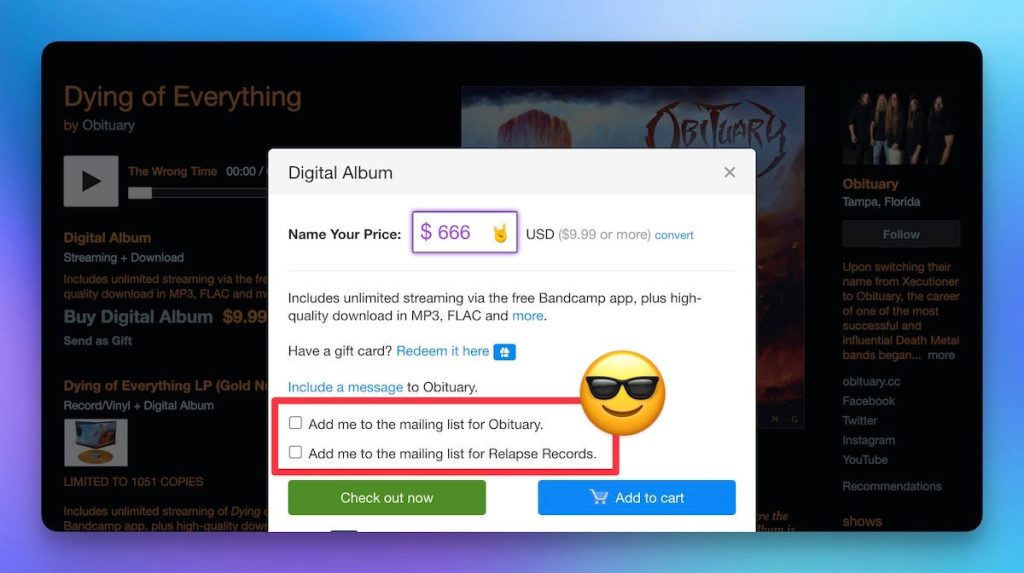
There’s the opt-in like “join this band’s newsletter.”
And that’s the key. As long as you’ve got that checkbox that establishes permission for that email, and that will make it good to go.
The only wary thing is if a band has had a Bandcamp up, and let’s say you’ve had it up for like five years, and you’ve never sent an email. Some of that permission will have gone stale, in the sense of, you send an email to someone and they’d be like, “I don’t know what this is from.”
And kind of industry wise, 12 months to 24 months is what you should look at for, how long email permission can last. Anything beyond that it’s probably best to kind of junk those older ones. It’s just not worth it because then you get into the what I was saying about, you know, you’re gonna have a lot of bounces, a lot of unsubscribes, or possibly even someone reaching out and reporting abuse, which can cause your domain to just be completely blocked, and you don’t want that.
I never thought of that past a year or 24 months kind of a thing. That makes a lot of sense.
So with Bandcamp, yeah, you can totally export those addresses out and send to ’em. You know, purchases alone can establish a type of permission as well. But you want to be on the the game about that.
A recommendation with that, so you see how people respond to that, when you upload it into Mailchimp, add tags that the signup source was Bandcamp. If you start to see some higher unsubscribes, they might need some different type of content, or you might need to create a welcome automation to kind of bring them into it.
Actually, right before we hopped on this call, I got an email from a punk rock label out of the UK, that I bought something off Bandcamp like six months ago. Okay, I had to think for a second, and I was like, “oh yeah, I bought the first High Vis LP off of this label.” And it was like, okay, yeah. Cool. And I ended up checking out the other stuff they had for the holiday sale.
That’s a thing of beauty when that works like that.
Here’s a softball question for you: why shouldn’t a band buy an email list?
Because those are people who have not given direct permission. They are a third party. They’ve gotten it from a third party, and historically it always creates high unsubscribes, high bounce rates, and the most important; high abuse rates, because people are like, “I didn’t ever sign up for this.” And if you’re a band, what does that gain you? That’s like the equivalent of going into a private party and throwing flyers for your show and then running out.
Should unsubscribes be taken so personally? I know folks that send to thousands of people and then they fret over two unsubscribes or something like that. It’s like, I mean, yeah, it’s a bummer. But like two isn’t a giant enormous number…
You gotta kind of see what that story is, what those unsubscribes are telling. There are many incidents of people who, uh, have reached out to unsubscribes because they take it personally, emailing them specifically and uh, that brings up a lot of privacy laws. Factor too because unsubscribes are supposed to be honored and especially if you’re dealing with an address in the EU, even more so.
Someone I know worked with a client that had like 10,000 unsubscribes over the years, and the client was like, “can’t we send an email to all the people that unsubscribed like a welcome back email?”
My friend there was like, “no, we can absolutely not do this.”
That is a violation of the US CAN-SPAM laws.
You cannot email an unsubscribe once someone has unsubscribed. That’s a very serious thing that can lead to fines in the thousands.
I would imagine anyone that has sent to 20,000 unsubscribed emails there would be some repercussions.
Yes. It is not good. And that will destroy your sending domain and then people don’t get to see your emails, and that’s kind of the point.
Yeah. Don’t engage in dumb behavior and people will see your emails then.
And the way to avoid that is to keep the audience engaged. Start looking at who’s not opening over time, and then sending them different types of content that’s really tailored towards them, to try re-engagement campaigns essentially. And focus on those. And then as well with that, looking at people who have not engaged over a long time and it’s like, well this whole batch of addresses has not opened a campaign in the last two years. Just get rid of those addresses. It’s just dead weight.
Send emails that people want. If you’re sending something a lot of people want to read and they open the emails, it will probably stay in their inbox, right?
Oh yeah. Without a doubt. If someone’s been engaged in opening, they can go through multiple times, most of the time depending on who their domain is, yeah, and not have it then start to get filtered. It takes a lot of inaction.
So like, if I signed up for your email list because I wanted updates from your band, and all you send is vinyl updates, I’m not gonna do anything with that, because I don’t even own a record player.
Look at the severity of things. People might unsubscribe because you send out four newsletters a month.
Right, right.
And that’s not what people want. Or you know, depending on how candid you are on social media, they might.
You can kind of link that into your unsubscribed stories as well. Like, you find a connection.
I have heard stories of different bands who like, you know, their one member is very vocal on Twitter, to a point where it kind of annoys fans, and then they see kind of less engagement. People might still be wanting to check out and buy their records and stuff, but they’re like, yeah, I don’t want to hear from them on a personal level.
At the same time though, again, it’s about managing expectations. Tegan and Sarah put together an email newsletter, I don’t know if you saw that, but like, they send like two or three a week, because their fans are like, “I want everything Tegan and Sara.” So they get away with that. Whereas bands that haven’t built that relationship, it wouldn’t make sense for them to send something every week.
Yeah. Billy Corgan has said this before, but bands have a contract with their fans, and you don’t know what that contract is.
It’s true.
Eventually you come to an understanding with each other of what that contract is. The band can buck that and do the opposite of it, but right. In the end they’ll end up losing fans cuz the fans had a certain expectation.
Right. Or you might end up with a 10% open rate.
Do bands come to you at all, like, “hey, I’m having problems” or this or that?
There’s been bands, there’s been record labels that I have come across my way in the compliance department because they had issues. We’ve worked to help them out. I can definitely say personally, I’ve worked with a few record labels that hadn’t touched their list in like six years and then they’re like, “okay, we’re doing a bunch of vinyl reissues, we want to start getting active again.” And it’s like, okay, let’s talk about your audience management, and how to make sure you don’t have an issue.
That’s great, and I think one of the biggest takeaways from this is that old list or those old emails and stuff like, that you can’t just like dust it off and go zero to 60 with it.
Yeah.
Just because you’ve got 20,000 addresses, that doesn’t mean that’s 20,000 addresses that want to hear from you today.
And these days bands, labels, whoever can set up a landing page or have a thing on their website for people to sign up. They’re getting the permission from that. That’s pretty much the golden way to do it.
Yeah. It’s finding the voice that you need with your fans and making sure to maintain your data.
And consistency, too. If you’re only sending out an email once a year, again, that goes back to your email’s age and stuff like that. So you gotta kind of hit it every now and again.
Exactly. You gotta make sure people are engaged in knowing of the brand, or they will forget why they even cared.

Linda Bloomfield started #OpportunityTuesday on Twitter in January of 2018, which is a weekly round up of paying gigs for creative folks in the UK.
What caught my eye was a Tweet (here) saying she’s moving Opportunity Tuesday to a newsletter format, so I reached out to understand her move from a social media network to an email list, which I think can be super helpful for lots of us!
I guess my first question is how long have you been doing Opportunity Tuesday? And is that how you built up to 16.5K followers on Twitter? That number of followers is no joke.
Linda Bloomfield: I posted the first thread back in January 2018 – can’t quite believe it’s been that long! I think I maybe had about 1,000 followers at that time, and I was working in an arts centre in London. I was constantly being emailed opportunities to “pass on to my network,” and started to question who that really was? And did it seem fair that people only had access to a lot of these opportunities if they were already in a ‘network’ of some kind?
It can be hard to find interesting paid opportunities in the arts as they’re not all shared in the same place, and frankly freelancers have enough unpaid admin to do without spending hours hunting for the next commission.
The first (Twitter) thread was a hit, and my following grew steadily – I tried to keep up the thread every week, with a few breaks for holidays, and now I somehow have 16.5k followers, which seems wild to me as outside of OppTues and the occasional theatre/arts chat I mainly post about nonsense: cooking, gardening, and my dog!
When did you see the writing on the wall regarding Twitter?
I owe a lot to Twitter – I can’t deny that my following has helped me build a profile and definitely helps me find more work – I’m freelance too!
So I’ve been following the Musk takeover closely and it really feels like things are headed down a rocky path. If Twitter even still exists in a few months I’m concerned it will no longer be a safe or trusted platform. I hope I’m wrong!
Did you consider moving Opportunity Tuesday to another social media platform?
I did consider other platforms. I know quite a chunk of “theatre twitter” has already jumped ship to Mastodon, but it just didn’t seem as “easy” and accessible as Twitter. Instagram doesn’t really work for words and links in the way I would need it to for OppTues, lots of people aren’t on Facebook anymore, and I’m too old for TikTok!
I follow a couple of other Substack newsletters and it has always seemed a clean, simple and accessible form of communication – so giving that a go now instead. It’s going well so far!
The thing I love here is you’ve been doing this since 2018. That’s four years, which is forever in internet time. And in your first post on Twitter, asking for people to sign up, you got about 1,200 people to sign up. From one Tweet, that’s great! But again, you built up four years of trust to do that, so when people saw “hey, subscribe here,” they did it. They trusted you.
I guess so. It’s very lovely! I’m just so glad people have found it useful for all this time. It’s my favourite thing in the world when people get in touch to say they’ve had successful applications for things they’ve found through Opportunity Tuesday!
Can you speak a bit about showing up for those four years? There had to have been slow weeks, right? Self doubt creeps in, “why am I doing this?” What kept you going all those years?
Oh my gosh, yes absolutely. There are definitely times I’ve regretted committing to 10 every week!
I genuinely put the hours in to find the “right” things for the list each week. I won’t, for example, just list standard jobs that wouldn’t be of interest to freelance artists, and I won’t list anything exploitative. So it takes around three hours every week and there are of course times I wish I didn’t have the commitment. I’ve occasionally been known to post at midnight, or “Opportunity Tuesday… on Wednesday,” and even once or twice have included an “interval” in the thread while I eat my tea or watch bake-off.
But people get it because I don’t get paid for this so it’s got to realistically work with my life. I’ve taken a few breaks over the years, for holidays, family stuff, or just when work is particularly chaotic – and people have mostly been kind, understanding and patient.
For the handful of times I’ve regretted starting it, there have been 1,000 times I’ve been so glad I did.
It feels like it’s bigger than just me now – a community has been built around it, one that celebrates open recruitment, fair pay, and support for freelancers, arts and culture. A bunch of other free lists and threads have sparked since 2018, often citing Opportunity Tuesday as their inspiration. I feel very proud.
And with your first email send, what was the reaction? I’m guessing you had like a 50% or higher open rate, right?! What’s the response been so far, from sending out these listings via email?
You can tell I’m new at this because I hadn’t actually checked until I saw this question! Oops. Looks like the first email on Tuesday received a 76% open rate – wow!
Since then we’re now up to just under 1,800 subscribers in total – I’m floored to be honest. And delighted it will be able to keep going this way, if / when twitter dies.
A few people are also chipping in real money now – access is the same for free and paid subscribers (and always will be) but people can choose to chip in £1 a week if they can afford to. The income isn’t huge but will mean I can properly make time for it each week going forward. As a freelancer myself, in a cost of living crisis, I can’t tell you how much I appreciate that!
A 76% open rate??! You are a legend. And it’s a testament against the silly notion that “nobody reads emails anymore!”
Compared to putting up these listings on Twitter, how was it different putting it all together in your first email? It was your first time, I know, so there’s a learning curve, for sure. But it’s nice to not have a character limit, right? Haha
Not going to lie, it took quite a bit longer than anticipated! But I think that’s just because it was my first time, and I’m also still cross posting to twitter at the moment which I won’t be doing forever (maybe).
Substack is a lovely platform though to use, really simple and clean, and it was a treat to be able to write as much as I like for the introduction and the end. It sounds silly, but OppTues has such a specific format that it’s hard to give it much…personality?
But you’re totally right, the change to email means each weekly list can come with a bit of razzamatazz and colour – an intro, a story, some context, a response to what’s going on in the world and in our industry for freelancers – that feels like an exciting opportunity.
I’ve already thought about adding in some news, links to other arts folk doing great things, stuff like that – it’s going to be fun to get creative and experiment. I’m sure the layout will get a little fancier in time too, once I’ve learnt the ropes! (It will probably always end with a photo of my rescue dog Mabel though, I reckon she’s the main reason the open rate is so high)
ANTI-SOCIAL
My absolutely-biased bunch of raging links against social media:
- “Instagram is telling creators when and why their posts are ‘shadowbanned’” – oh, how nice!
- “Facebook and Instagram are struggling to attract and retain the younger generation that’s crucial for their longevity. Why? The simple answer: Gen Z prefers video.”
- Speaking of video, “the rise of personalization and short-form video platforms means that the streaming services’ marquee editorial collections don’t drive as much listening.”
Ryan J. Downey is a reporter, podcaster, writer, manager, and a million other things, and still finds time to publish his Stream N’ Destroy newsletter a few times a week – and it’s one of the
Top 25Top 20 (as of Sunday, March 20, 2022) music newsletters on Substack!Why Substack, instead of something like Mailchimp?
Joe Escalante told me about Substack in November 2019. I liked the functionality, business model, and simplicity of the platform. Substack was far from ubiquitous at the time. In fact, it was new enough that my initial rush of subscriptions earned me a phone call from the CEO. I’m sure Stream N’ Destroy is small potatoes for them now, but I took that as another positive sign, encouraging me to continue down this path. I’m not supporting myself entirely with Substack by any means, but it earns plenty for me to feel great about investing so much time into it.
I was on MySpace in 2003; Facebook in 2005; Twitter in 2007; I’d like to think my early adoption of Substack is actually providing a great return.
The feedback (questions, suggestions, support) I receive from people is fantastic. They haven’t converted to the Substack comment section, but I suspect that’s because most of my readers are prominent figures (band members, managers, agents, label staffers, etc.) who don’t necessarily want to chat about this data in a public space. They just email me.
I enjoy finding new sources of data, organizing what’s relevant, and knowing that I’m making something that directly helps people I like and respect to put their art out there in the most effective and efficient ways possible.
In 2013 you planned to retire the email. Can you speak a bit to the work of just doing something like this for years? There’s up and downs, of course. What stuck with you, to keep doing doing this?
I sat at a dinner table with about a dozen colleagues after a show in 2013 when someone mentioned “Downey’s Scans email.” I made an offhanded comment about how I planned to retire it as it became harder to justify putting so much time into something I wasn’t sure meant anything to anyone else. A loud protest erupted around the table. People told me stories about how and why the weekly emails were of value to them. The positive reinforcement from that dinner propelled the newsletter for another six years.
Shortly afterward I moved the newsletter to Constant Contact (a platform similar to Mailchimp), primarily to give it a more “polished” look with a few graphics and space for a small amount of advertising. Over time, the metrics that matter multiplied. I changed the name from “A Few Scans…” to “Stream N’ Destroy” in recognition of the dominance of digital service providers like Spotify, Apple Music, and Pandora over traditional retail sales and physical media.
Social media, YouTube, concert attendance, merchandising — my goal is to gather all of the relevant numbers and distill them into something easy to read, saving my subscribers the considerable time and effort involved in tracking all of that down on a regular basis. Moving to Constant Contact and selling a small amount of advertising was a great and necessary step. But as the newsletter continued to expand – in readership, content, and frequency – that ad revenue no longer covered the time invested into the posts.
With the holidays approaching in 2019 I decided to “flip the switch” with monetization. (I set the weekly subscription rate to the bare minimum the platform allowed.)
I prepared myself for a flood of indifference, or even scorn, but I was pleasantly relieved by the outpouring of support from longtime subscribers. That encouraged me to continue this thing indefinitely, to work harder at it, and to constantly evolve and expand it to meet the needs of the folks who depend upon it.
You said, “I prepared myself for a flood of indifference, or even scorn;” where do you think that comes from?
A handful of people I know, myself included, sort of scoff that we could be compensated for this “thing we do,” without realizing, oh wait, “I know what I’m talking about, this might be of value to someone, so here’s a price tag.” How long was the debate with yourself about the move towards monetizing?
It’s probably left over from my experience in the punk and hardcore scene, where the spirit of the DIY/counterculture values is often coming from the right place, but the practice is messy and complicated. I did have one colleague/friend tell me I should never sell advertising for the newsletter, let alone subscriptions, as I should “do it for the love.” This same friend is a record executive with millions of albums sold by bands he personally A&R’d and handled. I wouldn’t expect him to do that for free and the more I thought about it, I shouldn’t work for free, either.
I run a Danzig fan account, This Day In Danzig, with close to 30k followers on Instagram. That is a labor of love. I’m happy to continue doing that for free. The newsletter, however, is fairly labor-intensive to put together and provides a unique service to some great people who have told me they rely upon it for various reasons.
(Keep in mind, I DID write these emails up for free for many years.)
I suppose the internal debate was in stages. First, whether to sell a small amount of advertising and later, whether or not to offer subscriptions.
Thankfully, the response to both measures was overwhelmingly positive.
You also said, “I’m not supporting myself entirely with Substack by any means.”
I see this a lot, among artists who believe their “one thing” should pay all the bills, and if it doesn’t they’re not really a photographer, or artist, or musician… that they aren’t really “doing it.”
Can you elaborate on this “multiple income streams” thing, a bit? It sounds very BUSINESS-like but man, if we can’t pay the rent it’s hard to be this artist person in the first place. Like, you do several things, just like a lot of people that work in music.
You make an excellent point! The last full-time job I had was with MTV News and that ended in July 2004 (though I continued to freelance for them for another decade after that). I do believe in the adage “jack of all trades, master of none” but as with many things, it’s about balance. I like having a handful of things happening both in terms of personal fulfillment creatively and from a practical standpoint. I have a couple of colleagues who are now executives at MTV who started before I did. But dozens more were swept away during layoffs and reorganizations of many kinds.
In 2022 I’m aiming to get more out of fewer things, but I can’t imagine being married to a single “thing.” I abandoned that notion that something wasn’t “real” if it wasn’t my “one thing” a long time ago. I mean, as a teenager, I was playing in a hardcore band, publishing a fanzine, putting on shows, working with Anti-Racist Action, going to school, and doing restaurant jobs part time.
As Ryan says, “Stream N’ Destroy is tailored to hard rock, metal, and punk(ish) music and culture, delivering relevant data about streaming, sales, concert attendance, and social media, distilled it into easy-to-read metrics for industry professionals.” If that’s your thing, you need to subscribe!
What I love about Stream N’ Destroy is it’s not Ryan’s “main thing.” He could have started a newsletter about all the interviews he’s done, or talked about the bands he’s managed, but instead he covers topics and trends that are helpful to those in the heavy music orbit.
Hit reply or contact me at seth@socialmediaescape.club – absolutely here to talk about all things email marketing for your creative projects!


I help creative people quit social media, promote their work in sustainable ways, and rethink how a website and newsletter can work together. Find out more here. 🏳️🌈🏳️⚧️
Join us — start a 30 membership and hop on our next Zoom call meeting!
Trying to figure out your email strategy, grow without social media, maybe not sure what to send to people? I’ve got Email Guidance spots open, and here’s how it works and how to book.
Prefer a focused conversation instead? Book a 1:1 call and we’ll dig into your work together.
Email me: seth@socialmediaescape.club
Subscribe via RSS