

I’ve climbed over 17,000’ since April 19th. This is in preparation for a half-marathon that I’m running in 12 days.
What the hell does this have to do with the Social Media Escape Club?
It’s practice.
It’s why I’m not telling you to delete your social media accounts today.
If you want to live a life without social media stealing hours of your day, start by deleting the app(s) from your phone.
That’s practice (you can reinstall them later if needed).
Try logging out of the accounts on your computer.
Practice (I logged out of LinkedIn today).
Turn off your phone, as Cody Cook-Parrott writes about in ‘Hope and Flowers’:
I know that my ability to earn is directly related to my ability to rest. Not just rest but to turn off the phone, to communicate with less people, and have less screen time. To read, to write, to really be without the phone. To turn the phone off. How many times can I type – phone off. Phone off. No phone. The phone is off. When was the last time you turned your phone off?
NOTE: there’s no need to reply and tell me you can’t do so because you’re caring for someone or you’re waiting for an important call from your doctor—I get it.
Experience being unavailable.
How does it feel when no one can reach you? Maybe journal those feelings. Record some audio of your experience, or a video. You don’t need to share it, but come back to it in a week and reflect.
As you live your life away from social media an hour at a time, you’ll discover that things don’t usually crumble. You don’t disappear.
As you practice being away from social media, you might miss something, so adjust accordingly. If a friend usually DMs you, tell them you’re taking a break tomorrow, and you can be reached via email or text.
If they resist, focus on those who respect your decision not to use services that negatively impact your mental health (I’ve absolutely done this).
Some things you can do in an hour instead of using social media:
- Go for a long walk, bike ride, or sit next to a lake
- Share a meal with a friend
- Read a book or a magazine
- Send a nice email to someone whose work you admire
- Call a friend and discuss art, movies, breakfast recipes, etc.
- Contact someone in your field about working together on a project
- Stare into space, the void, the darkness of time
One of my favorite things to do is take the photos, witty remarks, and hot takes that I used to post on social media and send them to a few friends instead or turn them into a blog post.
The spontaneous bits you’d post on social media can be the source material for your next newsletter, text to a pal, Discord group, or next live Zoom hangout with good people.
Like Professor Pizza of Axe Slasher said in one of our ESCAPE POD hangouts, “why should I give my best material to Twitter?”

Is it beyond comprehension that people at social media companies think of ways to make us dependent on their services? Could they actively be building a narrative that your participation is necessary?
First, consider the bait and switch: They got all of us to set up our profile pages for free and rewarded us with tons of views and likes. Eventually, we abandoned our websites, blogs, and email lists, and then they throttled our reach unless we paid to boost our posts or spent more time on their platform, uploading an un-ending stream of “content.”
Second, even if you don’t use their platforms to promote anything, you likely fell for the DM functionality to keep in touch with friends and family. But what if you get locked out of your account? What if your friend gets their account suspended for some random reason? What happens when one of your parents gets scammed and can’t log in?
If you lose touch with people you care about, you’ll figure out how to reestablish the connection quickly, usually by phone, text, or email—three pre-installed apps on every smartphone.
Remember – many people are paid well to keep you locked into their ecosystem. Escaping the world of social media ain’t easy, but that’s what Social Media Escape Club is here for.

I ran 1,105 miles in 2020, which took me around 200 hours.
Scrolling 33 minutes daily on your phone adds up to about 200 hours a year, too.
A friend told me recently that they want to start a newsletter, but they don’t want it to become a large time investment.
I told them that their next newsletter “is already written.”
Re-purposing the content you’ve already posted (on social media) means less time thinking about your next email newsletter, and gives you a jump on the creative process.
Once you have everything copied and pasted into your newsletter, you can make expand on some of your ideas, or include some other photos that you didn’t share on socials.
Most of us thought nothing of posting daily to social media, sometimes multiple times per day or per hour when an awards show was on or during a major sporting event.
Most of us have years of archival material to draw from, all tucked away in our social media channels.
Your posts only reach a fraction of your followers. Probably 90% of them never saw any of this material in the first place, so don’t feel bad about re-using your own material – it’s your material!
What could you do with just 30 minutes per day that might benefit you a year from now?
- Learn how to make scenic videos of lakes using a digital camera, Zoom H6 audio recorder, and editing the whole thing in DaVinci Resolve.
- Learning a new technique related to your craft
- Journaling and meditating
- Going for a walk, a bike ride, or go scootering (thanks, Amy Walsh)
- Dancing to your favorite records (R.I.P. mom)
- We think nothing of spending an hour a day on work meetings – what if we spent 30 minutes a day on FRIEND MEETINGS?
- Start a daily 30-minute check-in video call to help everyone stay on track and encourage one another
Sometimes, these things sound like too much, but each day, we have choices: invest in ourselves or create shareholder value for corporate behemoths.
Consider that we don’t think twice about uploading our original photos and text to a platform that sells advertising around our unpaid labor while limiting the number of our friends (or potential clients) who will ever see it, thus incentivizing us to either spend more of our time (a finite resource) on the platform “engaging,” or spending actual money to “boost” our posts so more people might see it.

There are three places to start when writing a newsletter.
1. Sharing
A link you shared with a friend can be your next newsletter. It might be topical, about a recent event or a new idea.
You could also dig through the archives on your blog or newsletter or your social media profile and re-share links that meant something a year ago or 10 years ago, like this blog post I wrote a decade ago:
“Every one to one interaction is priceless. It’s valuable. It can’t be outsourced, and you can’t just get some unpaid college intern to do it.”
Remember – something you shared 18 months ago was probably seen by just 8% of your followers – and you’ve probably gained more subscribers over the last year and a half!
2. Storytelling
We’ve all got stories, some big, some small.
I was taking some photos around town a few days ago, and the owner of the barbershop yelled, “come take our photo!”
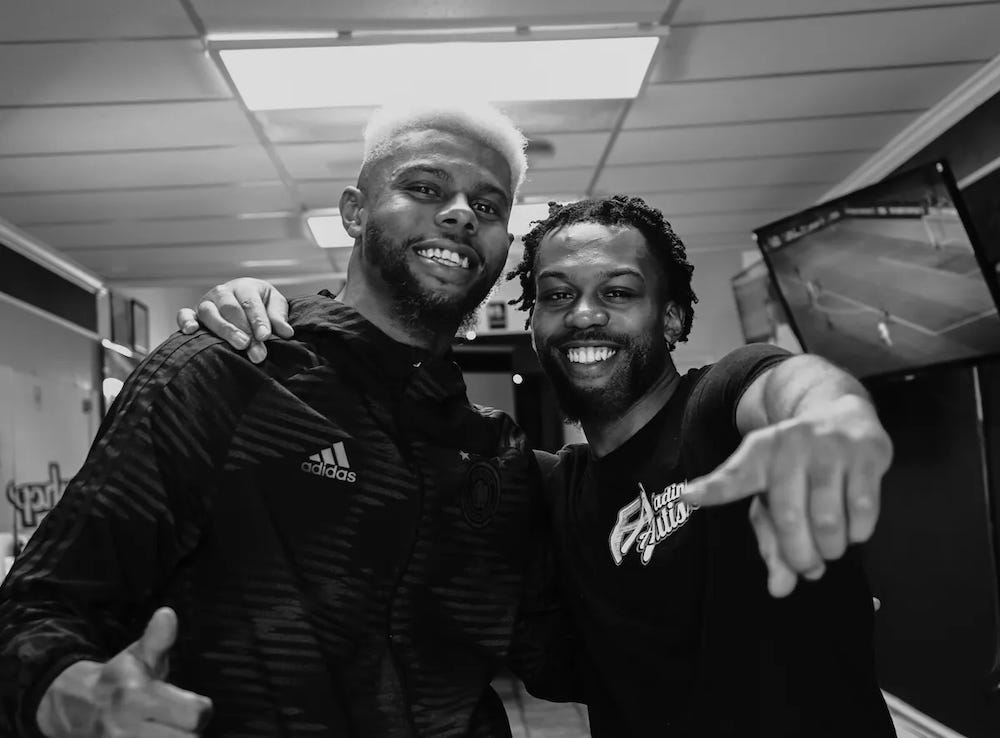
Now, that doesn’t happen very often, but it made for a fun story!
Here’s some other stories I haven’t told yet:
- That time I invited by highschool buddy to NYC to hangout when I had the Deftones come to our studio for an interview.
- How I ditched all my belongings in 2010 and left Brooklyn with my bike and my laptop and rode to Rutherford, NJ to start my nomadic bike nerd journey and ended up in Albuquerque, New Mexico.
- When a manager for a big Grammy Nominated band told me they had a problem with my interviewer minutes before we were supposed to go live on a podcast.
You’ve probably got stories, and your subscribers would probably love to hear them.
3. Showing
This is the default, the starting point, the simplest thing to write about in your newsletter, but you have to do it in a way that feels right.
In last week’s ‘Social Media Support for Artists’ (hosted by the wonderful Beth Spencer), someone spoke about taking photos of her sketchbooks and then dreading the idea of posting them to social media and writing captions for each.
Someone suggested, “Make it a video!” And for this person, that resonated.
If you dread doing something, you’re probably not gonna do it. And if you do it reluctantly, everyone is gonna know you’re being pissy about it. The vibes will be off, my friend.
Here are two examples of sharing and keeping the good vibes:
- Noah Kalina sent a newsletter about making egg cups, which was a story from a magazine that had come out several months prior.
- Taylor Pendleton made a video of her walking around Death Valley taking pictures. No music. No dialogue.
Do I dread running? Well, I love eating pizza a lot more, that’s for sure.
But I do love being outside. So running gets me outside, into the space I love. And then I love sharing photos and videos from being outside, way more than making “infographics” or whatever to try to promote my work.
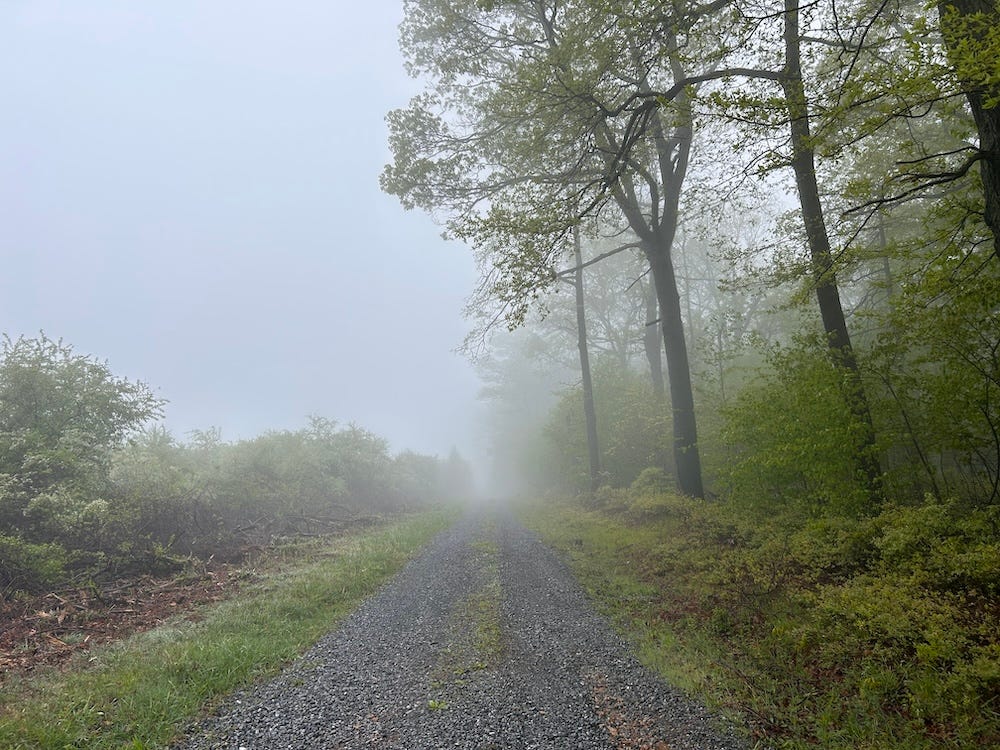
By sharing a glimpse of what I love, it shows a bit of who I am, and maybe that resonates with a few people.
Getting off social media has to be more than just “yeah, but how will I still sell stuff?” It’s about the time you regain, which allows you to explore, learn, and grow.
So don’t get sad about writing a newsletter, thinking you’ve got nothing to write to your subscribers—you’ve got plenty to write about, share, and explore with the people who’ve signed up and said, “Yes, I want more of what you have.”
You are more interesting than storage lockers, and that show has been on air longer than Seinfeld.
I wrote about Mullet Marketing about a year ago, and if you’re guilty of it, you’re depriving your most engaged fans of your best work.
Let me explain.
The mullet can be described as “business up front, party in the back.”
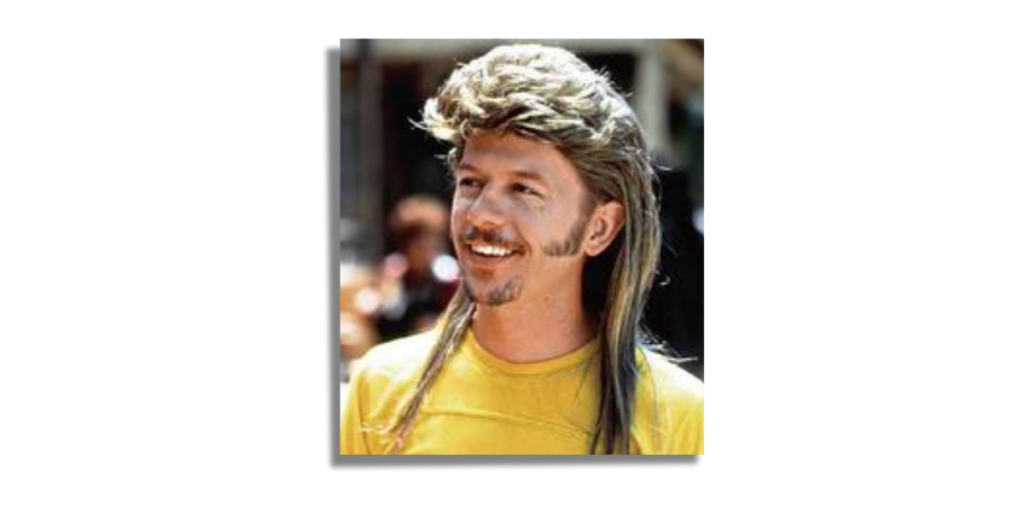
PARTY IN THE BACK: This is most everyone’s social media feed, where you see live photos from events, gallery openings, and shows. Also, photos of dogs, record shops, and your workspace. It’s videos, 300-word captions, and where we voice support for various organizations and causes.
BUSINESS UP FRONT: This is most everyone’s email list, where we get static images of products, mock ups, poster art with teeny tiny text, details, facts, locations, prices, deals, and colorful buttons labeled BUY NOW or SHOP HERE.
This is why we cringe when our favorite artists say, “Sign up for updates,” or “Join my newsletter!”
We’ve all signed up for enough newsletters to know that most of them suck.
So here’s an idea – make a newsletter that doesn’t suck.
Wild concept, I know.
You wouldn’t share a stock photo on social media, so why use one in your newsletter? Re-use the photos you’ve already put on socials!
And what is the best part about writing a paragraph about your latest project in a newsletter? More than 10% of your audience will actually read it!
You gain a certain amount of energy when you know your creative output is actually being seen, and that energy is exactly what you need to continue producing your best work.
In a recent newsletter titled “Backstage” (which went out to 10,000+ email subscribers) Tegan from Tegan and Sara wrote about putting out a live album. Maybe release it on vinyl, CD, and cassette, “with a booklet with photos from the tour.”
Then goes on to say:
“Maybe we should hold some stuff back, I suggested, and keep the stories and recordings and photos for that. It would be nice to have images and videos that no one has seen. For social media, for the booklet. Right? Or maybe it doesn’t matter; we share so much content (we = everyone) at this point, who even remembers what’s been posted and hasn’t?”
As I’ve been saying for years, re-use photos from social media in your newsletter because most of your followers never saw them.
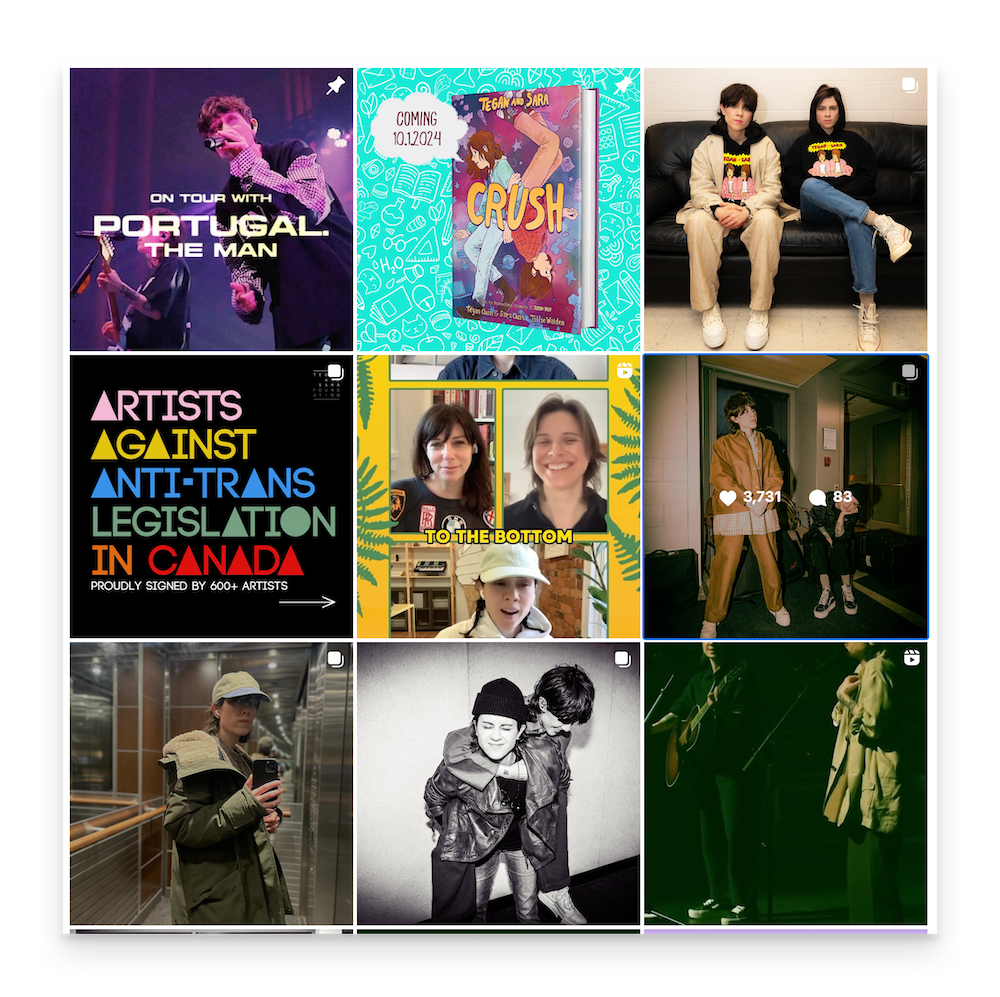
The Tegan and Sara Instagram has 470,000 followers, and the last nine posts got an average of 3,444 likes, meaning 0.7% of their fans liked any one of those images.
Two of those posts have over 100 comments. That’s 0.213% of their fans that left a comment, and that’s on a good day.
Mind you, Tegan and Sara are a Grammy-nominated indie pop duo who’ve been making music for over 25 years.
I’m not saying don’t be on social media (well, maybe I am); just lower your expectations of actually ever reaching 10% of your followers.
Understand that posting an IG Reel to your 3,500 Instagram followers will probably be seen by just 250 people, and if 1% click a link, well, that’s a solid two people that might see your offering.
A friend of mine deleted his social media accounts in 2017 or so. He’s played drums for 30+ years; that’s all he wants to do, be a musician.
He joined some bands he found on Craigslist, did some recording gigs with friends on the internet, played a lot of local shows, learned a lot of covers, and made a few bucks.
He just wanted to play drums, you know?
We talked on the phone recently, and he told me of a “secret” group he’s in, with a bunch of other local musicians. They meet once a week and jam and hang out.
This didn’t happen overnight, but now my friend is in multiple local bands, and playing drums all the time with great people. He’s never been happier.
All without a Twitter account or posting crowd shots on Instagram stories.
This is what I meant when I wrote, ‘Social media loses power when we build community in other places.’
Tegan and Sara were here before social media, they’ll be here when it’s gone.
The creator economy existed long before Zuck and Musk showed up.
There was a time when we didn’t speak of our work as “content.”“Make cool stuff, show it to your friends,” says Rick Rubin. Friends, family, fans. You get the idea.
But if a platform doesn’t let you show your cool stuff to your friends, ask if it serves you anymore. If not, it might be time to rethink things.
I made the above video reply for my Substack pal Mariah Friend, who is “diving into the world of offering live events/workshops with the hope of building community and engaging more directly with my readers.”
You can find her original comment here.
“Unfortunately, I’ve had little to no engagement. I have around 370 subscribers and offer both free/donation based events and ticketed events… so far, I’ll have 2-3 people sign up on Eventbrite but then not show up. This honestly makes me anxious because hosting a workshop for a live audience vs. doing a recorded workshop with NO audience has a very different flow! I’m not sure how to best prepare for a scenario I’m uncertain about until it’s happening.”
Hosting these events can be a lot of fun, and build lots of goodwill among your subscribers, but getting them to show up can be a challenge!
Hopefully, this video is helpful. Every situation is unique, and every audience is different, so take everything I mention with a grain of salt and then apply it however to your process.
I shared Michelle Warner’s concept of getting “awareness” off our own plate about a month ago and have tested it in a few ways.
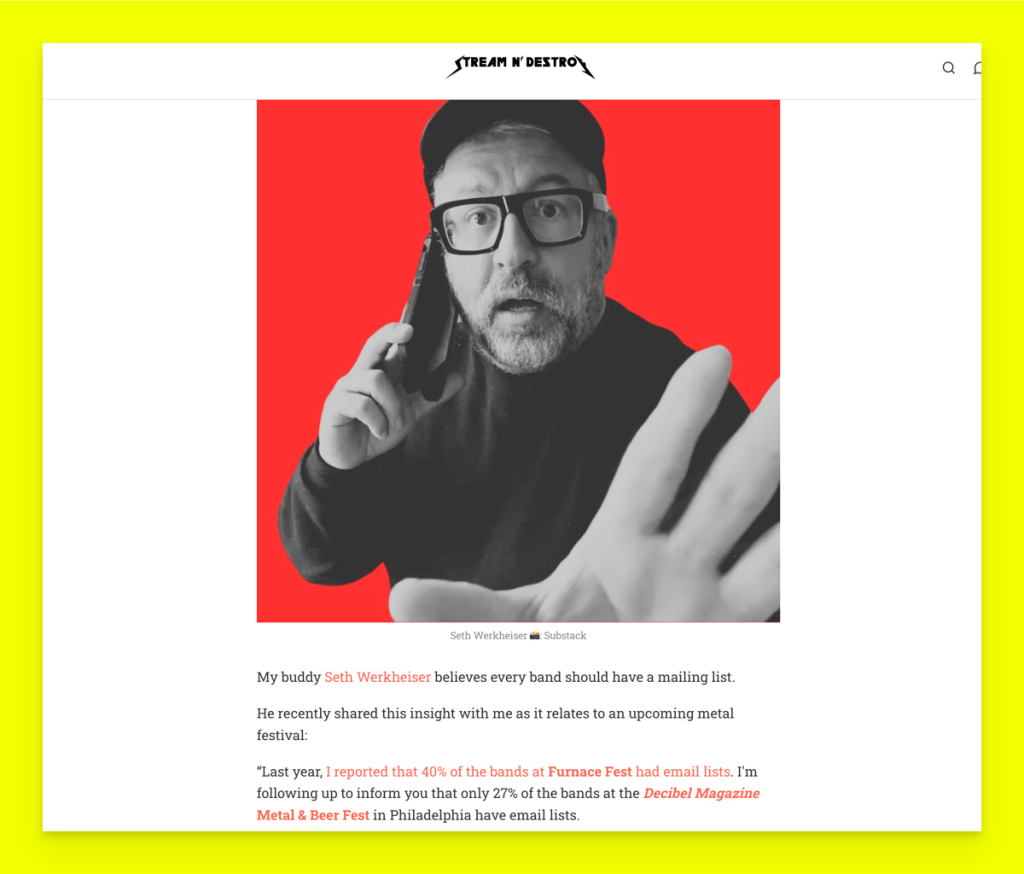
First, I pitched an article to Ryan J. Downey, for his Stream N’ Destroy newsletter (above). I felt it fit better on his “platform” than here since I don’t focus on metal bands as much as I used to when this newsletter was called Heavy Metal Email!
Only 27% of the bands at the Decibel Magazine Metal & Beer Fest in Philadelphia have email lists.
Six have websites.
That means four of the 14 bands performing can reach their fans directly via email. Since signing up for all four email lists 25 days ago, I have yet to receive any updates.
Here’s what happened: It’s hardly been a week and it brought in about five new subscribers. That might not seem like a lot, but giants in the heavy metal and hard rock industry read Ryan’s newsletter, so that’s fine with me!
Here’s how you can do it: Ask someone you know if you could offer something for their audience. Maybe it’s artwork for a newsletter series, an audio jingle for their voiceovers or podcast, or something else that supports the work they’re already doing. Maybe someone who makes videos could use your original music or animations.
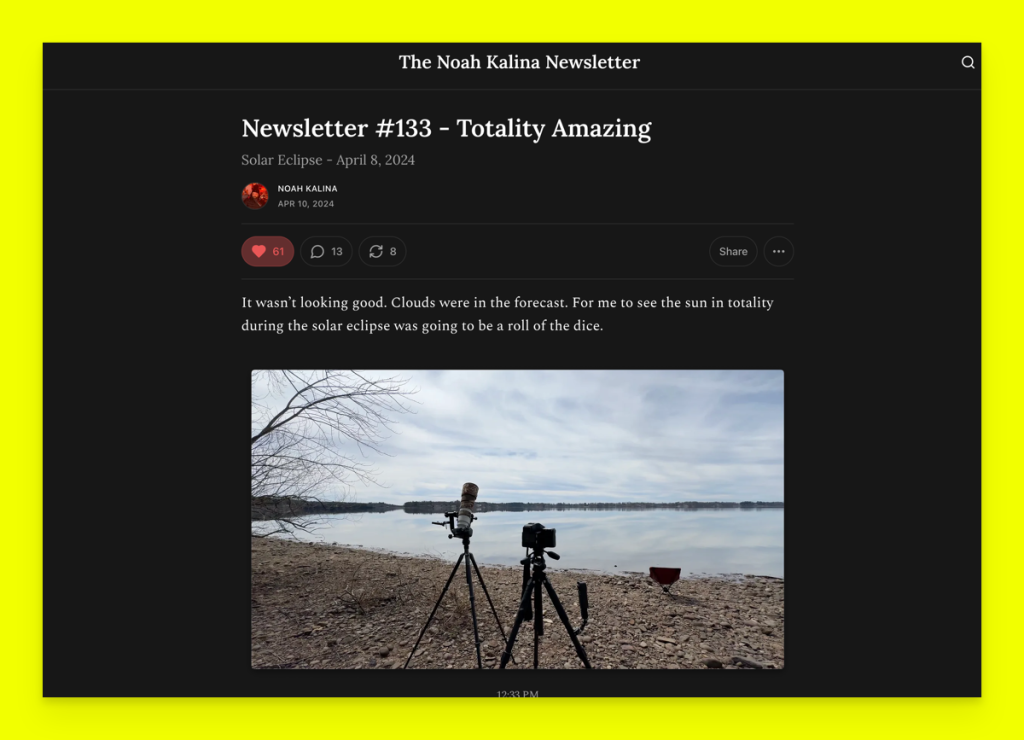
Second, I helped artist/photographer Noah Kalina move his newsletter from Mailchimp to Substack. He mentioned wanting to restart his newsletter in his new YouTube videos, so I sent him an email, we had a good Facetime chat and got to work. His newsletter lives on and he’s got happy subscribers!
Here’s what happened: Noah credits me as his “newsletter guru” in the footer, and he gave me a Substack Recommendation, which led to about 35 new subscribers. I also reconnected with two wonderful artist friends who saw my name in his newsletters, too.
Here’s how you can do it: If someone is asking, offer a skill as a way to support someone in their creative journey. I’m not into the whole “cold email” thing, but if you see someone looking for help and you feel somewhat confident in your abilities, hit them up – you never know where it might lead!
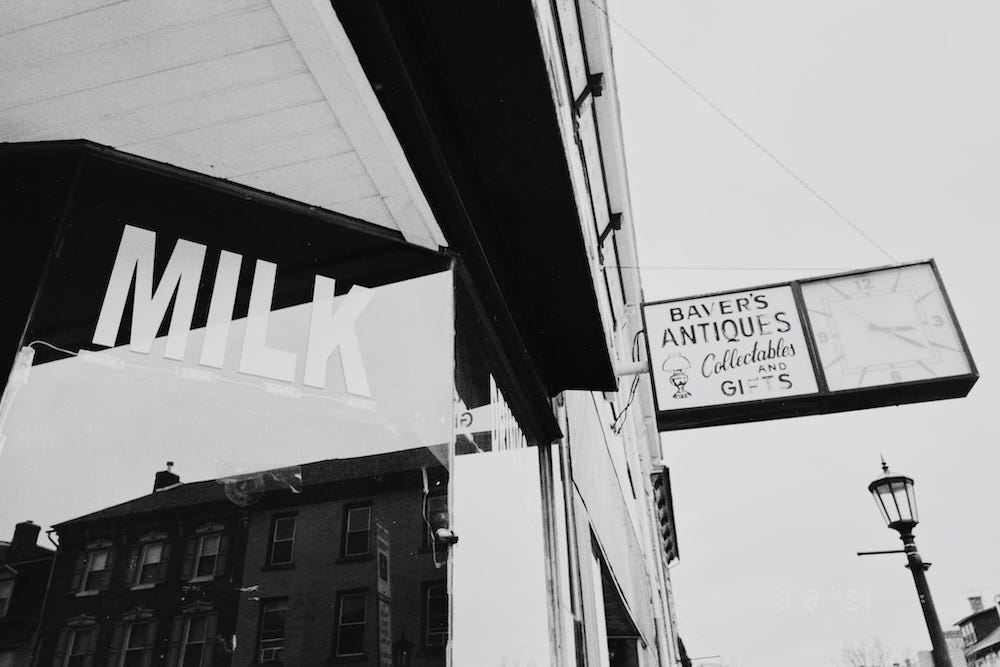
Third, I submitted the above photo for Photo Talk, which is put together by Marcel Borgstijn. Folks vote in a poll about the clarity and engagement of the photo and leave comments, too. It was terrifying but a lot of fun at the same time!
Here’s what happened: This led to a few subscriptions, but this was just a fun thing to do, and I met some very talented photographers in the process!
Here’s how you can do it: If you see someone doing cool things with other people, ask if you can join in!
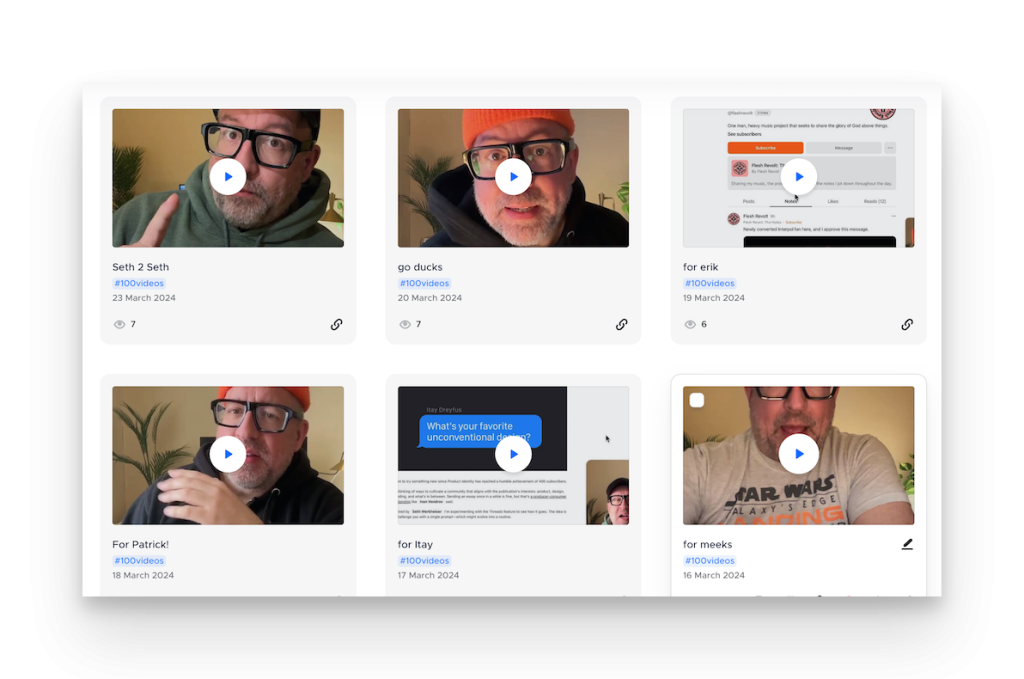
I’ve also replied to about 15 people by making individual videos for them and answering their questions or expanding on their ideas.
Why do all this? Well, maybe you missed it from my recent ‘Maybe you don’t need more subscribers’ post:
Setting a timer for 15 minutes and communicating with real people five days a week will probably get you more results than the hour you spend making one Reel for 153 “people” to see (and which will never be seen again after 12 hours).
Does it scale? Fuck scale, do the work.
Everything I listed above was way more fun than “creating content” to drive “awareness” on services that are turning from social media into paid advertising platforms.
Talk to good people, nurture your creative network, and reach out to people you haven’t talked to in a while. Use video, send a text, a postcard, or voice note. Call them on the phone, meet for coffee, axe-throwing, and/or putt-putt golf.
Yes, we’d all love to just post our work and be done, but occasionally connecting with the energy of other creative people will give you new perspectives on what you’re trying to accomplish.

I help creative people quit social media, promote their work in sustainable ways, and rethink how a website and newsletter can work together. Find out more here. 🏳️🌈🏳️⚧️
Join us — start a 30 membership and hop on our next Zoom call meeting!
Trying to figure out your email strategy, grow without social media, maybe not sure what to send to people? I’ve got Email Guidance spots open, and here’s how it works and how to book.
Prefer a focused conversation instead? Book a 1:1 call and we’ll dig into your work together.
Email me: seth@socialmediaescape.club
Subscribe via RSS