
Category: Social MediaCategory: Social Media

It’s Friday, so another Four the Weekend – four things I hope you’ll do by Monday.
- If you’re still on social media, ask one person to subscribe to your email newsletter. Yes, one. Avoid saying “sign up for updates.”
- Watch ‘Real Art Matters In a Digital World’ by Joshua Heath Scott, then think about how you can bring your digital work into the real world (thanks Zach Sprowls).
- Did you make a video to promote something you’re selling? Try embedding it on your sales page, instead of sending your fans to YouTube. I explain why here.
- Practice leaving social media and experience being unavailable. Be bored and do nothing for a few minutes. Leave your phone in the car.
You know that if you leave a comment, someone will see it. That’s how it works.
You also know that screaming from a street corner will get you some weird looks and not many positive interactions.
Where then is a good place to put our energy? What’s the best use of our time?
We are so entagnled in this “micro-blogging” quick fix life. It’s so easy to post a photo, a remark, an opinion. In the past the social media overlords swung the attention in our favor. They knew our friends would hit like, and some friends of friends.
They knew we could get addicted to this. So they slowly pulled it away, so some people who relied on (small businesses, creators, etc) would start paying for the impressions.
It was all a house of cards, and it’s crumbling.
But now as we return to blogging (like this), or email list, the rush isn’t there. The likes don’t flow like they used to. Fewer replies.
Which then makes us long for the social media hit. The quick fix. Post again, and again.
It’s gone, and it ain’t coming back.
The fulfillment we seek is already in us, it’s never from something outside (thanks, Alex for that one).

In middle school I always had the latest issue of BMX Plus, and wore Airwalk shoes that mom ordered for me from the JCPenny catalog. I grew my hair long and wore a Batman cycling cap.
I was sending signals, people! So were you. Even right now. Everything we do and how we operate is a secret nod to those who might “get it.”
The signals you send say, “this is the stuff I do, come say hello.” I was sending lots of “I’m into cool music and I want to be in a band” signals at that time.
The kid with the black jean jacket and a Bon Jovi shirt got my signal in 5th grade. Years later I’d join his band (which changed my life).
What signals are you putting out today?
How can you send better signals?
And how can you make sure your signal doesn’t get lost in the noise?
The below only really applies to the Substack platform, but I think the logic behind it can carry over into other places.
Stop begging the Substack Notes algorithm to “send you” cool people to follow.
Sending signals to social media algorithms is a poor use of time.
I bet you already subscribe to / follow at least one interesting person on Substack, right?
Go to their profile (here is mine) and check out all the posts they LIKE and the publications they subscribe to.
See? Now you’ve got tons of interesting people to discover via someone’s unique taste and cool vibe discernment.
It’s all about the “liner notes.” Find people involved with the cool videos you watch on YouTube, or the people who leave comments, or dig through the guests on your favorite podcasts. Find out who they’re following, who they’re writing about and sharing about.

It’s Friday, this is Four the Weekend – four things you can do by Monday that’ll be more productive than hours of scrolling social media.
- Watch my ‘Talking About About Pages’ workshop replay, update your About page, and email a friend in your creative orbit to take a look at it, preferably in person (or on a Zoom call). I also spoke at length with the very wise Alex Dobrenko` this week – you can watch that here.
- Clean up your Link in Bio. Better yet, trim it to 2-3 links; starting with your own website and somewhere to subscribe to your email list.
- Get talking to people in your existing creative orbit. Email, set up a call, meet in person. Vent for the first 15 minutes, sure, but then start talking and dreaming about the way you want to work the rest of 2025 (like more photo walks with friends).
- Read the section ‘Don’t kill the attention of mourners’ from ‘The Art of Gathering‘ (chapter five) by Priya Parker. Are you leading with logistics, or leading with magic and wonder?
1. Make your own Twitter
I mentioned recently that you should make your own Twitter, and it’s been fun seeing some subscribers run with the idea:
- https://pappasbland.com/feed
- https://timmcfarlane.com/work/the-almost-daily-art-life
- https://shinydesigns.com/category/studio-updates-feed/
We update our websites because platforms disappear.
For instance, Posts was a nice platform for designers and artists and programmers. I found it a few years ago, and discovered some cool art and a few apps.
It’s shutting down in May.
All the photos and designs will go away. All the stories about making vector animations or silk screen posters will no longer exist.
This is why we need our own feeds, on our own websites.
2. Join my About “About Pages” Workshop
Join me for a one-hour interactive workshop where we’ll focus on crafting or improving your About/Bio page. Whether it’s for your website or Substack, we’re work together to create something that aligns with your vibes.
➡️ Thursday, Feb 13 – 2-3:00 PM EST – Register and get the Zoom link here
I’ll have have links to various About pages for inspiration, and we’ll talk about what every good About page should have, but I won’t be clicking through a deck and lecturing for an hour – heck no!
The even is free, but you can name your own price at check out if you’d like to support my work.
- Yes, this workshop will be recorded
- Yes, you should register even if you can’t attend so I can send you the replay video
- No, this won’t be a lecture
- Yes, this will be chatty and we will take time to work on our about pages in real time
- Yes, it’s free / pay what you want
➡️ Thursday, Feb 13 – 2-3:00 PM EST – Register and get the Zoom link here
3. Check your SEO Description
Google your publication or website and see what comes up.
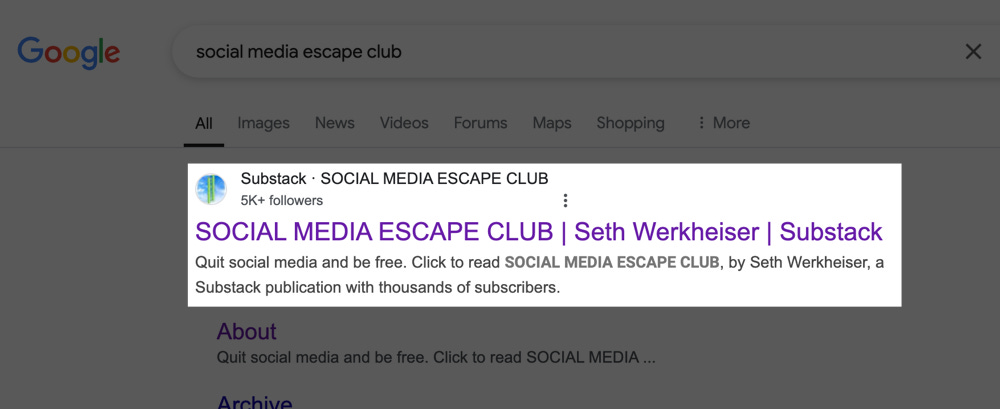
This is updated on Substack here:
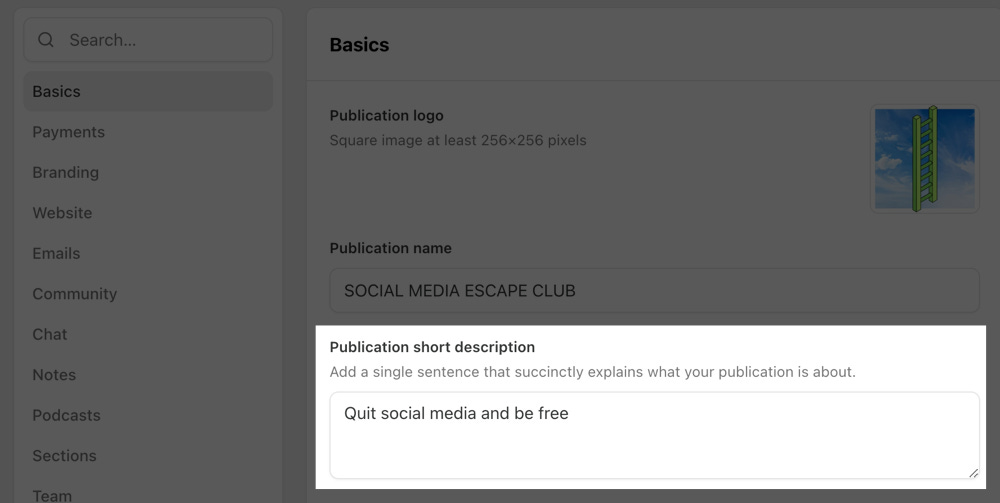
Skip the “hello, and welcome to my musings and whimsical thoughts that flutter through my noggin” intros and tell potential readers what they get before clicking.
Can you explain your work in one sentence? In five words?
4. Leave the house
From our pal Dedicate Your Life To Music (link):
Streams don’t make your career.
Followers don’t make your career.
People do.
If your career is stagnant, go to shows.
Get involved in your local scene.
Make friends and play house parties.
Meet people who love live music.
If your music is good, people will be so excited to share it with others. But they can’t do that if you’re fucking around at home worrying about your Spotify numbers.
This is universal wisdom, as it can be applied to other art forms, too.
Go to book readings, art galleries, photo exhibits, museums, craft fairs.
Be around the people you want to be around. Work hard at making good stuff, instead of obsessing over unsubscribes or clicks.
The experiences and lessons you learn make you who you are. We’re not talking just “words on a screen” or “lyrics to a song,” because this is 2025 and bullshit AI bots can do those things. Not well, but they can.
So that’s why we need to get out into the ugly real world, have some awkward conversations, show up someplace and not know anyone. Skip the algorithmic shortcuts that everyone else tries to game and cut in line by knowing people. Making connections. Networking but not in a gross way, but in a “omg my life is filled with amazing people” way.
AI bots can’t show up in venues on a Tuesday, or your D&D night.
Hop on a Zoom call with some fellow freaks. Or stay home and invite people over. Start a knitting club, a book club, a vinyl record club, a “show us the photos you made this week” club.


You’re tired of social media, but wondering if there’s life after the newsfeed. That’s exactly what we figure out here – together. 🏳️🌈🏳️⚧️
→ See our upcoming Zoom schedule
Say hello. Ask about working together. Tell me how you’re doing: seth@socialmediaescape.club
Subscribe via RSS